
If you’ve ever received a message that simply says “JW,” you might have paused for a second and wondered what it means. Don’t worry—you’re not alone. Internet slang can feel confusing, especially when abbreviations are super short and depend heavily on context.
In this guide, we’ll break down the real meaning of “JW” in text, how people use it in everyday conversations, and how you can understand (and use) it correctly without feeling lost. Everything is explained in simple, beginner-friendly language so you can follow along easily.
What Does JW Mean in Text?
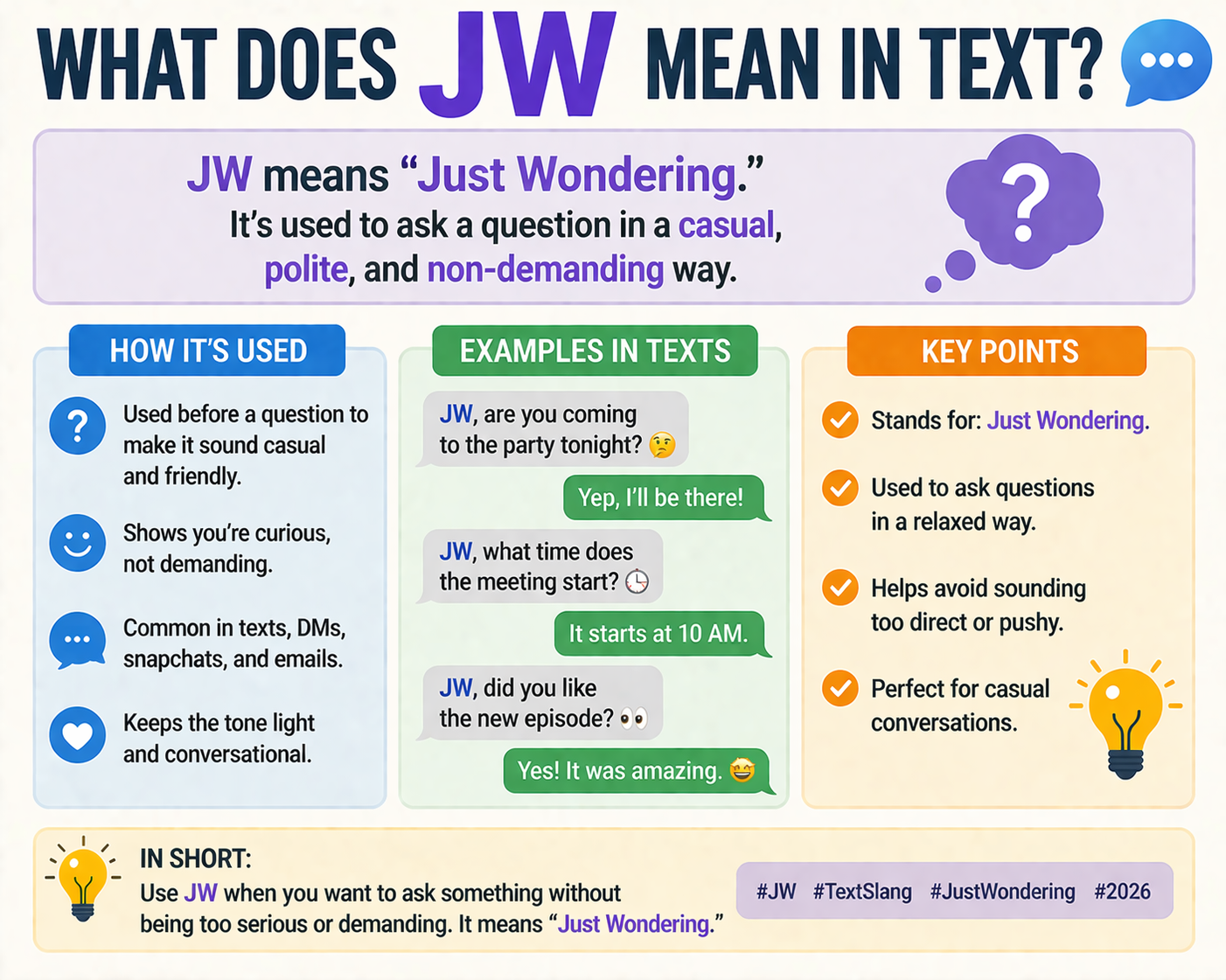
“JW” usually stands for “Just Wondering.”
It’s commonly used in texting and online chats when someone wants to ask a question casually—without sounding too serious, demanding, or intrusive.
Think of it as a softer way to ask something.
Instead of directly asking a question, people add “JW” to make it sound more relaxed or polite.
Simple Explanation of JW
At its core, “JW” is a tone-softener.
It helps make a question feel:
- Less direct
- More casual
- More friendly
For example:
Instead of saying:
“Why didn’t you reply?”
Someone might say:
“Did you see my message? JW”
👉 The “JW” makes the question feel less aggressive and more easygoing.
How JW Is Used in Texting
Let’s look at how “JW” appears in real conversations so you can understand it better.
Example 1: Casual Question
Text: “Are you coming tonight? JW”
👉 Meaning: Just asking casually, no pressure.
Example 2: Checking Something
Text: “Did you finish the assignment? JW”
👉 Meaning: Curious, but not demanding.
Example 3: Friendly Curiosity
Text: “Why were you offline all day? JW”
👉 Meaning: Interested, not accusing.
Example 4: Social Media Comment
Comment: “Where did you buy this? JW”
👉 Meaning: Curious about the product.
Why Do People Use JW?
People use “JW” because tone matters a lot in text messages.
Without facial expressions or voice, messages can easily sound:
- Rude
- Pushy
- Too serious
Adding “JW” helps fix that.
It shows:
- You’re not pressuring the other person
- You’re just curious
- You’re being friendly
JW Meaning on Social Media
“JW” is widely used across different platforms. Let’s see how it appears in each.
On Instagram
Used in comments or DMs.
Example:
“Where is this place? JW”
👉 The person is curious but not demanding an answer.
On Snapchat
Often used in quick chats.
Example:
“You didn’t reply earlier, everything okay? JW”
👉 Sounds caring instead of confrontational.
On TikTok
Seen in comments when viewers want more information.
Example:
“How long did this take? JW”
👉 Shows interest without sounding pushy.
Is JW Always Polite?
Most of the time, yes—but context still matters.
“JW” is meant to soften a question, but depending on how it’s used, it can still feel:
- Neutral
- Curious
- Slightly passive-aggressive (rare, but possible)
For example:
“Why are you ignoring me? JW”
👉 Even with “JW,” this can feel a bit tense.
So while “JW” helps, the wording of the sentence still matters.
JW vs Other Similar Slang
There are other slang terms that serve a similar purpose. Here’s how “JW” compares.
1. “Just asking”
Very similar, but more direct.
2. “Out of curiosity”
A longer, more formal version.
3. “If you don’t mind me asking”
More polite, often used in formal conversations.
4. “No pressure”
Used to reduce expectations.
“JW” is simply the shortest and most casual version.
When Should You Use JW?
“JW” works best in informal situations.
Good Times to Use JW
- Chatting with friends
- Casual texting
- Social media comments
- Asking light questions
When to Avoid JW
- Professional emails
- Job-related communication
- Talking to someone you don’t know well
- Serious or emotional conversations
Using slang in formal situations can make you seem unprofessional.
Tone Matters with JW
Even though “JW” softens a message, tone still depends on the full sentence.
Let’s compare:
“Are you busy? JW 😊”
👉 Friendly and polite
“Why didn’t you reply? JW”
👉 Slightly tense
“Where were you? JW…”
👉 Can feel suspicious
So always consider the full message—not just the abbreviation.
Common Mistakes People Make
1. Thinking JW Has Multiple Meanings
In texting, “JW” almost always means “Just Wondering.”
However, in other contexts, it can mean different things (like organizations or names), but in casual chat, it’s simple.
2. Overusing JW
Using it in every message can feel unnecessary.
Example:
“Are you coming? JW”
“What time? JW”
“Where? JW”
👉 This can feel repetitive.
3. Using JW in Serious Situations
If someone is upset or discussing something important, adding “JW” might seem dismissive.
Real-Life Conversation Examples
Let’s look at more natural conversations.
Scenario 1: Plans
Friend: “We might go out later.”
You: “Where are you going? JW”
Scenario 2: School
Friend: “I finished the project.”
You: “When is it due? JW”
Scenario 3: Online Shopping
Post: “New shoes just arrived!”
Comment: “How much were they? JW”
Scenario 4: Gaming
Friend: “I stayed up all night playing.”
You: “Which game? JW”
Scenario 5: Daily Life
Friend: “I’m taking a break from social media.”
You: “For how long? JW”
How to Reply When Someone Says JW
If someone adds “JW” to their message, they’re just asking casually.
Here’s how you can respond:
1. Answer Normally
“No, I haven’t finished yet.”
2. Keep It Light
“Haha yeah, just busy today”
3. Ask Back
“Why do you ask? 😄”
There’s no pressure—you can respond naturally.
Is JW Still Popular in 2026?
Yes, “JW” is still commonly used.
Even though new slang appears all the time, “JW” remains popular because:
- It’s short
- It’s useful
- It fits everyday conversations
It’s especially common in quick chats where people want to keep things casual.
How JW Fits Into Modern Communication
Slang like “JW” shows how digital communication is evolving.
People prefer:
- Short messages
- Friendly tone
- Low-pressure conversations
Instead of sounding demanding, people now soften their words using abbreviations like “JW.”
Tips to Use JW Naturally
If you want to use “JW” like a native texter, keep these tips in mind:
- Use it occasionally, not in every message
- Keep your tone friendly
- Avoid serious topics
- Combine with emojis if needed
Example:
“Are you coming tonight? JW 😊”
JW vs Full Phrase: Which Is Better?
Both are correct—it depends on the situation.
Use “JW” when:
- You want to be quick
- You’re texting casually
Use “Just wondering” when:
- You want clarity
- You’re speaking more formally
Final Thoughts
“JW” is a simple and useful texting abbreviation that stands for “Just Wondering.” It helps make questions feel softer, friendlier, and less demanding.
Whether you’re chatting with friends, commenting on social media, or asking a quick question, “JW” is a great way to keep things casual and polite.
The key is understanding context and tone. When used correctly, it makes your messages feel more relaxed and natural. But like all slang, it works best in informal situations.
Now that you know what “JW” means in text, you’ll be able to recognize it instantly—and even use it confidently in your own conversations.
Discover More Post
Clever Elephant Puns That Make You Smile 2026
Best Apple Puns for Daily Smiles 2026 – Styled By Vibe –