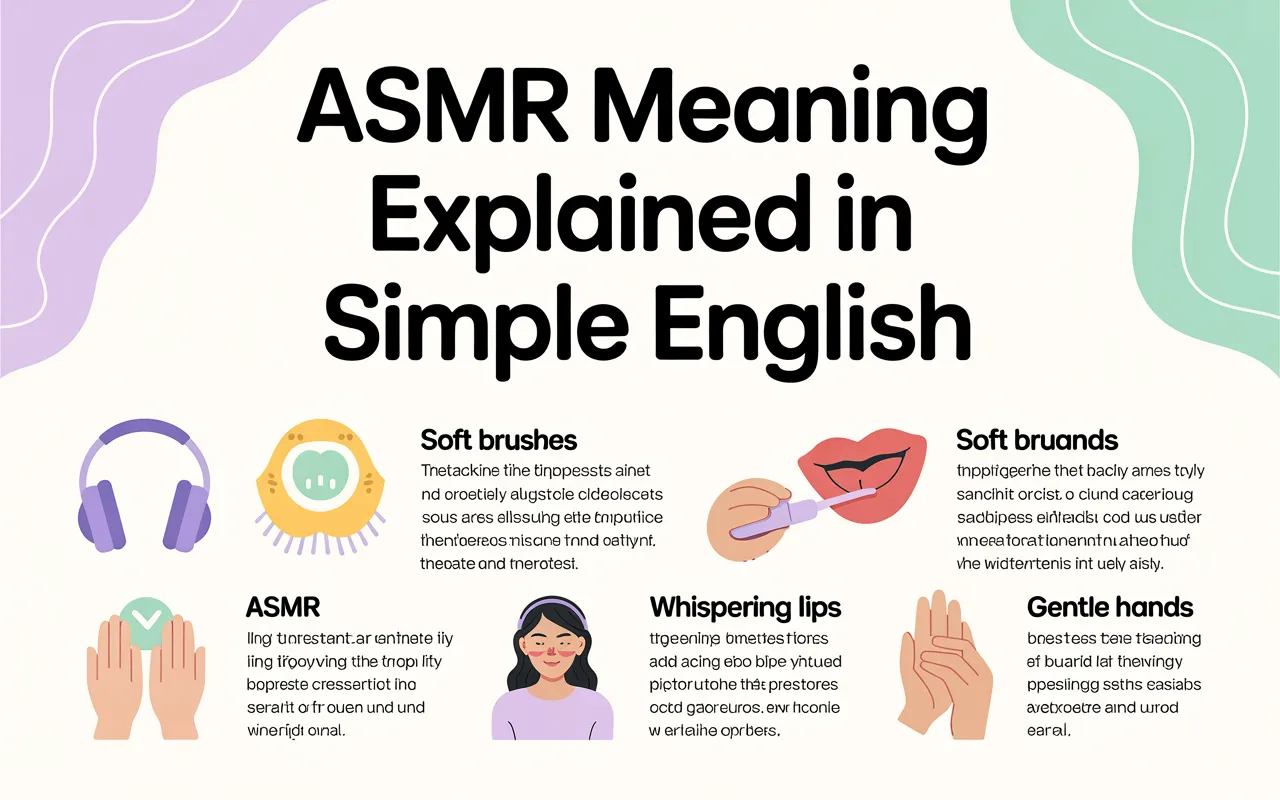

If you have ever watched someone whispering softly into a microphone tapping on objects, or brushing a camera slowly and felt a strange relaxing sensation, you have already experienced what many people call ASMR.
Thousands of people search this keyword every day because they hear the term on YouTube, TikTok, or social media but do not fully understand it. Some think it is a medical condition. Others believe it is just a trend. Many are simply confused by the strange name.
In simple terms, ASMR is connected to relaxation and calming feelings triggered by sounds or visuals. Yet, the real explanation is deeper and more interesting than most people expect.
1. ASMR Meaning – Quick Answer
The ASMR meaning stands for:
Autonomous Sensory Meridian Response
It describes a relaxing, tingling sensation some people feel in the head, neck, or spine when they hear soft sounds or see gentle movements.
Simple Explanation:
ASMR is a feeling of deep calm caused by specific sounds or visuals.
Real Examples of ASMR Meaning in Action:
- Whispering videos: A person whispers softly into a microphone → Many viewers feel relaxed or sleepy.
- Tapping sounds: Fingernails tapping on wood or glass → Creates a soothing, rhythmic effect.
- Hair brushing sounds: Slow brushing noises → Helps people feel calm and reduce stress.
So when people search ASMR meaning, they are usually trying to understand why these sounds feel so relaxing.
2. The Origin of ASMR Meaning
The ASMR meaning comes from a scientific-sounding phrase:
- Autonomous = happens automatically
- Sensory = related to senses (hearing, sight, touch)
- Meridian = peak or high point feeling
- Response = reaction of the body
The term ASMR was first used in 2010 by Jennifer Allen, who wanted a neutral name for this strange relaxing sensation people were reporting online.
Before this, there was no official name. People described it as:
- “Brain tingles”
- “Head shivers”
- “Relaxation waves”
The creation of the term helped people understand and talk about the experience more clearly.
So, the modern ASMR meaning is not ancient—it is a relatively new internet-born concept that quickly became global.
3. British English vs American English (ASMR Meaning Usage)
The ASMR meaning does not change between British and American English because it is an acronym. However, usage and cultural understanding can vary slightly.
Key Differences:
| Feature | American English | British English |
|---|---|---|
| Popularity | Very high on YouTube and TikTok | Growing but slightly less mainstream |
| Content style | Fast-paced ASMR trends | More calm and traditional relaxation content |
| Usage context | Entertainment + stress relief | Mainly relaxation and sleep aid |
| Search behavior | High volume searches for ASMR meaning | Moderate but increasing interest |
Example Usage:
- US: “I watch ASMR videos every night to sleep.”
- UK: “ASMR helps me relax after work.”
Even though the ASMR meaning stays the same, cultural usage shapes how people experience it.
4. Which Version Should You Use?
Since ASMR is an acronym and not a spelling variant, there is no “correct version” to choose between British or American English.
However, understanding your audience matters.
Use ASMR content for:
- Global audience: Use simple explanation of ASMR meaning
- US audience: Focus on entertainment and relaxation benefits
- UK/Commonwealth audience: Focus on calm, sleep, and wellness
- Academic or formal writing: Always explain full ASMR meaning first
Expert Advice:
If you are writing or creating content, always introduce the full ASMR meaning first before using the short form “ASMR.”
5. Common Mistakes with ASMR Meaning
Many beginners misunderstand the ASMR meaning. Let’s fix the most common mistakes.
Mistake 1: Thinking ASMR is a disease
❌ Wrong: “ASMR is a medical condition.”
✔ Correct: ASMR is a sensory relaxation response.
Mistake 2: Thinking everyone experiences it
❌ Wrong: “Everyone feels ASMR.”
✔ Correct: Not everyone feels ASMR; it varies by person.
Mistake 3: Confusing ASMR with relaxation music only
❌ Wrong: “ASMR is just soft music.”
✔ Correct: ASMR includes sounds, visuals, and personal triggers.
Mistake 4: Using ASMR meaning incorrectly in writing
❌ Wrong: “ASMR meaning is music for sleep.”
✔ Correct: ASMR meaning refers to a sensory response, not just music.
Understanding these mistakes helps you use the ASMR meaning correctly in real life and writing.
6. ASMR Meaning in Everyday Usage
The ASMR meaning is now widely used across digital platforms and daily communication.
1. Emails
- “We created ASMR-style audio for relaxation content.”
2. Social Media
- “This ASMR video helped me sleep instantly 😴”
3. News and Blogs
- “ASMR content is growing in digital wellness trends.”
4. Formal Writing
- “Autonomous Sensory Meridian Response (ASMR) is studied for relaxation effects.”
The keyword ASMR meaning often appears in digital wellness, mental health, and entertainment industries.
7. ASMR Meaning – Country-wise Popularity & Search Intent
The ASMR meaning is searched globally, but popularity varies.
High Search Interest Countries:
- United States
- United Kingdom
- Canada
- Australia
- South Korea
- India
- Pakistan
Why People Search ASMR Meaning:
Most search intent falls into 3 categories:
- Curiosity: People hear the term online
- Experience explanation: They feel tingling and want answers
- Content creation: YouTubers and creators researching trends
Context-Based Usage:
- Teenagers: entertainment and relaxation
- Adults: stress relief and sleep aid
- Creators: content strategy and niche growth
So, the ASMR meaning is not just a definition—it is part of a global digital culture.
8. Keyword Variations Comparison (ASMR Meaning)
Here is a clear breakdown of how people search this keyword:
| Variation | Meaning | Usage |
|---|---|---|
| ASMR meaning | Full definition of ASMR | Most common search |
| What is ASMR | Basic explanation | Beginner users |
| ASMR full form | Expansion of acronym | Students/learners |
| ASMR explained | Detailed breakdown | Content readers |
| ASMR definition | Formal dictionary style | Academic use |
All variations lead back to the same core idea: understanding the ASMR meaning as a sensory relaxation response.
FAQs About ASMR Meaning
1. What is the simple ASMR meaning?
ASMR means a relaxing tingling sensation caused by soft sounds or gentle visuals.
2. Is ASMR scientifically proven?
Some studies suggest ASMR helps relaxation, but research is still ongoing.
3. Why do people feel ASMR differently?
Not everyone is sensitive to ASMR triggers, so reactions vary by person.
4. Is ASMR good for sleep?
Yes, many people use ASMR videos to fall asleep faster and reduce stress.
5. What triggers ASMR?
Common triggers include whispering, tapping, brushing, and slow movements.
6. Is ASMR safe?
Yes, ASMR is completely safe and used for relaxation purposes.
7. Can anyone experience ASMR?
No, only some people naturally experience the ASMR response.
Conclusion (Final Expert Summary of ASMR Meaning)
The ASMR meaning is more than just a long scientific phrase. It describes a real sensory experience that many people feel when exposed to soft sounds or gentle visuals. Over the past decade, ASMR has grown from an internet curiosity into a global relaxation trend.
In simple words, ASMR helps people feel calm, relaxed, and sometimes sleepy. It is not a medical condition, but a natural response that varies from person to person.
Understanding the ASMR meaning helps you better navigate modern digital content, especially on platforms like YouTube and TikTok where ASMR videos are extremely popular.
Discover More Post
What Does GNG Mean in Text Real Meaning Examples 2026
What Does BTS Mean in Slang Real Meaning Examples 2026
What Does Lmfaooo Mean in Text Real Meaning Examples …