
If you’ve ever received a message that simply says “JW,” you might have paused for a second and wondered, What does that even mean? You’re not alone. Internet slang can feel confusing, especially when short abbreviations have multiple meanings.
The good news? “JW” is actually one of the simpler slang terms once you understand how it’s used.
In this guide, we’ll break it down in plain, beginner-friendly language. You’ll learn what “JW” means in text, how people use it in real conversations, and when it’s appropriate to use it yourself.
What Does JW Mean in Text?
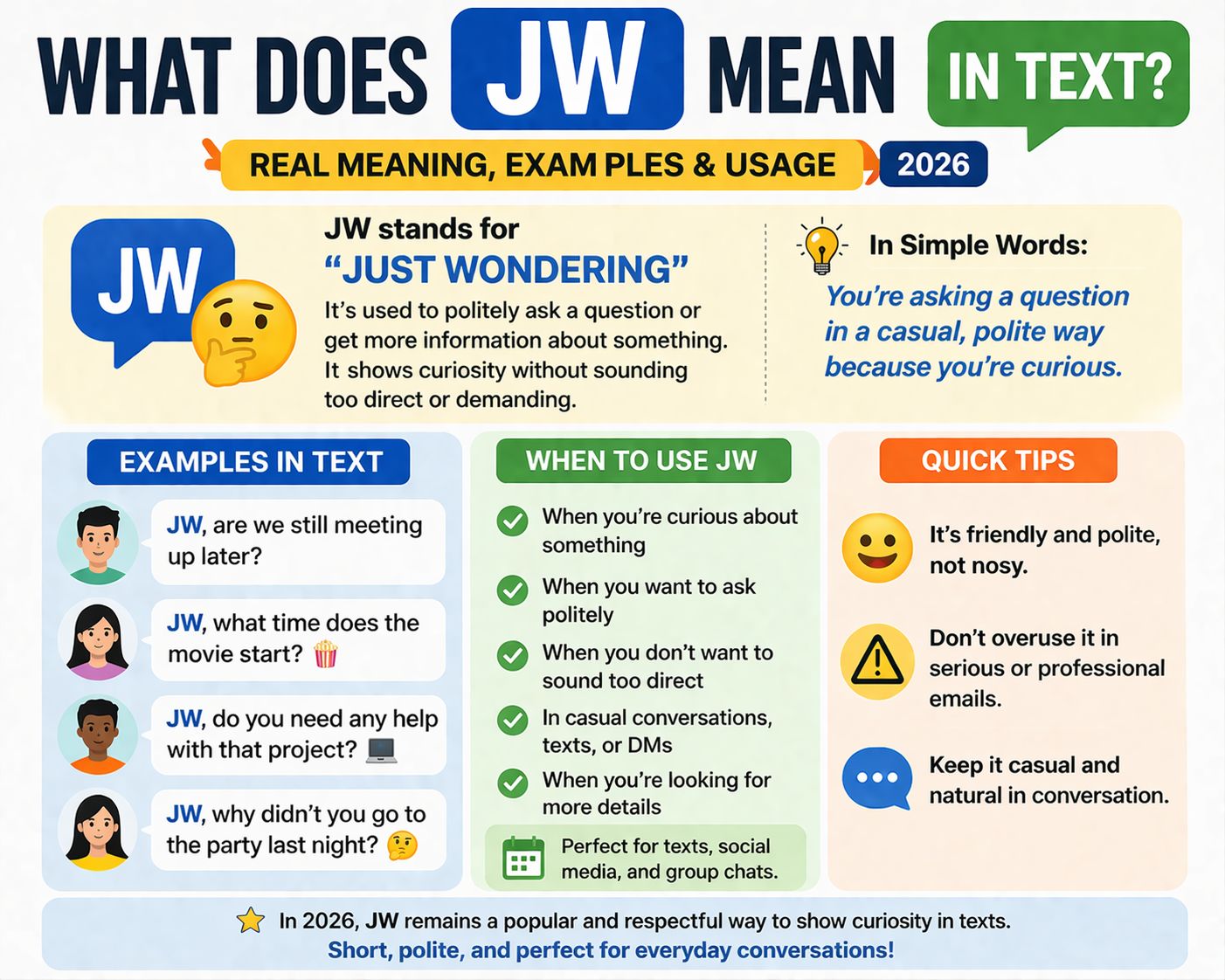
In most texting and social media conversations, “JW” stands for “Just Wondering.”
It’s used when someone is asking a question casually, without wanting to sound too serious, demanding, or intrusive.
Think of it as a softer, more polite way to ask something.
Simple Explanation of JW
At its core, “JW” is a tone-softener.
Instead of asking a direct question, people add “JW” to make it feel lighter or less awkward.
For example:
- “Are you mad at me?” → feels serious
- “Are you mad at me? JW” → feels softer and more casual
It shows curiosity without pressure.
Why People Use JW in Texting
Text messages can sometimes sound harsh or blunt because you can’t hear tone of voice. That’s where slang like “JW” helps.
People use it to:
- Avoid sounding too direct
- Make questions feel casual
- Reduce awkwardness
- Show they’re not demanding an answer
It’s especially useful when asking something slightly personal.
How JW Is Used in Real Conversations
Let’s look at some everyday examples so you can see how natural it feels.
Example 1: Casual Curiosity
Message: “Are you free tonight? JW”
👉 Meaning: You’re asking politely, without pressure.
Example 2: Checking Feelings
Message: “Did I say something wrong? JW”
👉 Meaning: You’re concerned but don’t want to sound dramatic.
Example 3: Asking About Plans
Message: “Have you finished the assignment? JW”
👉 Meaning: Just checking, not pushing.
Example 4: Light Question
Message: “Why did you leave early? JW”
👉 Meaning: Curious, not accusing.
JW on Social Media
While “JW” is more common in private messages, it still appears on social platforms.
On Instagram
People use it in DMs or replies.
Example:
“Why did you delete that post? JW”
On Snapchat
Very common in casual chats.
Example:
“You didn’t reply yesterday, JW”
On TikTok
Less common in comments, but still used in messages.
Example:
“How did you edit this video? JW”
Is JW Always Polite?
Most of the time, yes—but context matters.
Even though “JW” softens a question, the message can still feel uncomfortable depending on what you’re asking.
Friendly Use
- “Are you coming today? JW 😊”
Slightly Awkward Use
- “Why are you ignoring me? JW”
The second one still feels a bit intense, even with “JW.”
So while it helps, it doesn’t completely change the meaning of the question.
Tone Matters a Lot
Since texting doesn’t include voice tone, small details change how “JW” feels.
With Emojis
“JW 😊” → Friendly and relaxed
Without Emojis
“JW” → Neutral
With Dots
“JW…” → Can feel hesitant or awkward
Other Meanings of JW
While “Just Wondering” is the most common meaning, “JW” can have other meanings depending on context.
1. Jehovah’s Witness
In some cases, “JW” refers to the religious group Jehovah’s Witnesses.
Example:
“He’s JW”
👉 Meaning: He belongs to that religion
2. Initials or Names
Sometimes “JW” is just someone’s initials.
Example:
“I talked to JW today”
3. Rare Slang Uses
In very rare cases, it might mean something else, but these are uncommon in everyday texting.
How to Know Which Meaning Is Intended
Context is everything.
Ask yourself:
- Is it part of a question? → likely “Just Wondering”
- Is it describing a person? → possibly initials or religion
- Is it in a casual chat? → almost always “Just Wondering”
Most of the time, especially in texting, it means “Just Wondering.”
When Should You Use JW?
“JW” works best in casual, everyday conversations.
Good Situations
- Chatting with friends
- Asking light questions
- Checking in on someone
- Clarifying something politely
Situations to Avoid
- Formal emails
- Work messages (unless very casual)
- Serious or emotional discussions
- Talking to someone you don’t know well
Using slang in the wrong place can make you seem unprofessional or unclear.
How JW Compares to Similar Slang
There are other abbreviations that serve a similar purpose.
1. “BTW” (By The Way)
Used to add extra information.
Example:
“BTW, are you coming?”
2. “IDK” (I Don’t Know)
Shows uncertainty.
3. “TBH” (To Be Honest)
Used to express honesty.
4. “Just asking”
A full phrase version of “JW.”
All of these help shape tone in digital conversations.
Common Mistakes People Make
1. Overusing JW
Using it too often can feel repetitive or unnecessary.
2. Using It in Serious Topics
Example:
“Why didn’t you tell me the truth? JW”
This can come off as passive-aggressive.
3. Assuming It Fixes Tone Completely
Even with “JW,” a sensitive question can still feel uncomfortable.
Real-Life Scenarios
Let’s go deeper with realistic situations.
Scenario 1: Friendship
“Hey, you’ve been quiet lately, JW”
👉 Shows care without sounding pushy
Scenario 2: School
“Did the teacher change the deadline? JW”
👉 Simple and polite
Scenario 3: Relationships
“Are we still okay? JW”
👉 Softens a serious question
Scenario 4: Work (Casual Environment)
“Did you send the file? JW”
👉 Acceptable only in relaxed workplaces
Scenario 5: Curiosity
“Why did you unfollow me? JW”
👉 Curious, but can feel awkward depending on tone
How to Reply to JW
If someone sends you “JW,” they’re asking something casually.
Here’s how you can respond:
1. Answer Normally
“No, I’m not mad at you!”
2. Keep It Light
“Just busy yesterday 😄”
3. Ask Back
“Why do you ask? 👀”
You don’t need to treat it as a serious question unless the topic is serious.
Why JW Is Popular
“JW” has stayed popular because it solves a real problem in texting: tone.
It helps people:
- Sound less direct
- Avoid awkwardness
- Keep conversations casual
In a world where messages are short and fast, small abbreviations like this make communication smoother.
Is JW Still Used in 2026?
Yes, “JW” is still widely used.
Even though slang changes quickly, some abbreviations stick around because they’re simple and useful—and “JW” is one of them.
It may not be as trendy as newer slang, but it’s still common in everyday conversations.
Tips for Using JW Naturally
If you want to use “JW” like a native texter, keep these tips in mind:
- Use it at the end of a question
- Keep the message casual
- Add emojis if needed
- Don’t rely on it for serious topics
- Match the other person’s tone
Final Thoughts
“JW” stands for “Just Wondering,” and it’s one of the easiest and most useful texting abbreviations you can learn.
It helps make questions feel softer, friendlier, and less direct—something that’s very important in digital communication where tone can easily be misunderstood.
As long as you use it in the right context, “JW” can make your messages feel more natural and polite.
Now, the next time you see “JW” in a text, you’ll know exactly what it means—and how to respond without confusion.
Discover More Post
Funny Lizard Jokes That Never Get Old 2026 – Styled By Vibe –
What Does LYLYK Mean in Text Real Meaning Examples 2026