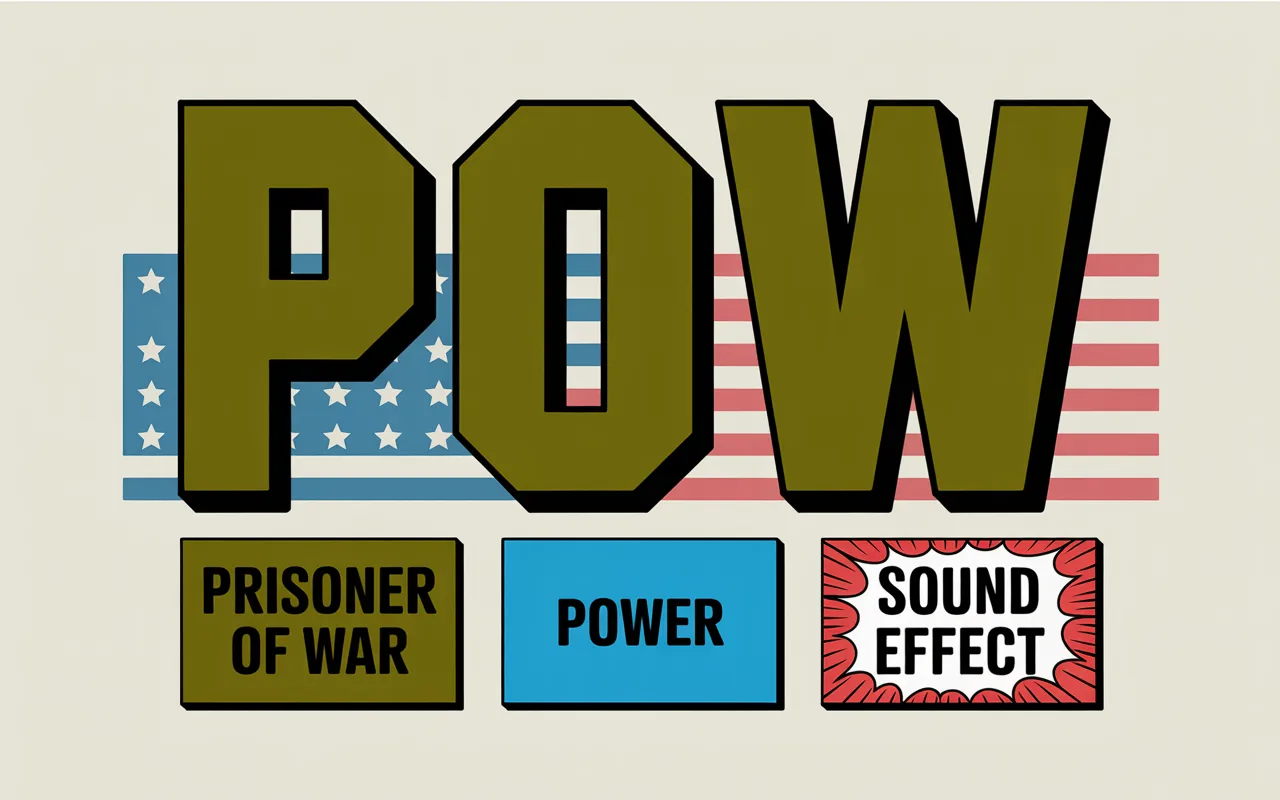

Many people search online asking one simple question: what is a POW. The reason is clear. They see this word in movies, history books, news, or war documentaries, but they are not fully sure what it really means.
Some think it is a modern slang. Others confuse it with military codes or abbreviations. But the truth is simple and very important to understand.
The term POW is mainly connected with war and history. It describes a situation where soldiers are captured during armed conflict. This concept has been used for many years and is still important in international law today.
People search what is a POW because they want clarity. They want to understand its full meaning, origin, and how it is used in real life. This article will explain everything in very simple English. No complex words. No confusion.
By the end, you will clearly understand what a POW means, where the term comes from, and how it is used in different situations around the world.
1. What is a POW – Quick Answer
A POW (Prisoner of War) is a person who is captured and held by the enemy during a war or armed conflict.
In simple words:
A POW is a soldier who is caught by the opposing side during fighting.
Easy Examples:
- A soldier captured during a battlefield fight becomes a POW.
- During World War II, millions of soldiers were held as POWs.
- International laws protect POWs from harm or unfair treatment.
Key Points:
- POW = Prisoner of War
- It applies only in war situations
- It mainly refers to soldiers, not civilians
- International laws like the Geneva Conventions protect POWs
So, when you ask what is a POW, the answer is simple: it is a captured soldier in wartime.
2. The Origin of POW
The term POW (Prisoner of War) comes from military language used for centuries.
Historical Background
The idea of capturing enemy soldiers is very old. Ancient civilizations like Rome, Greece, and Persia already had prisoners during battles. But they did not use the modern term “POW.”
The abbreviation POW became widely used in modern times, especially during:
- World War I
- World War II
During these wars, millions of soldiers were captured. Governments needed a simple term to describe them, so Prisoner of War (POW) became standard.
Why the Term Became Important
As wars became more organized, countries agreed that captured soldiers should be treated humanely. This led to international agreements like:
- The Geneva Conventions
- Rules of war protection
So the word POW is not just a label. It is connected to human rights in war.
3. British English vs American English
The term POW is used in both British and American English. However, usage style and pronunciation in media or writing can slightly differ.
Comparison Table
| Feature | British English | American English |
|---|---|---|
| Term used | POW (Prisoner of War) | POW (Prisoner of War) |
| Pronunciation | Pee-O-Double-U | Pee-O-Double-U |
| Usage style | Formal military reports | Common in media & films |
| Frequency in news | Moderate | Very high |
Key Insight
There is no difference in meaning. Both British and American English use POW the same way. The difference is only in tone and usage style.
4. Which Version Should You Use?
If you are writing, speaking, or learning English, you might wonder which version is correct.
The answer is simple:
- For global use → POW is universal
- For academic writing → Use full form Prisoner of War
- For casual writing → POW is fine
- For news or history → Both are acceptable
Best Practice
- Use POW in short writing, notes, or headlines
- Use Prisoner of War in formal essays or research papers
This ensures clarity for all audiences.
5. Common Mistakes with POW
Many beginners misunderstand the term what is a POW and make simple mistakes.
Mistake 1: Thinking POW is a civilian term
❌ Incorrect: Civilians captured in conflict are POWs
✔ Correct: POWs are usually soldiers, not civilians
Mistake 2: Using POW for police arrests
❌ Incorrect: A criminal arrested by police is a POW
✔ Correct: POW only applies in war situations
Mistake 3: Confusing it with slang
❌ Incorrect: POW means “power” or slang expression
✔ Correct: POW = Prisoner of War
Mistake 4: Thinking POW is a modern internet term
❌ Incorrect: POW is internet slang
✔ Correct: It is a military and legal term
Understanding these mistakes helps you use the word correctly in real situations.
6. POW in Everyday Usage
Even though POW is a military term, you still see it in daily life.
1. Emails and Articles
Writers often use POW in history discussions:
- “The soldier was taken as a POW during the war.”
2. Social Media
People use it in history posts or documentaries:
- “Stories of WWII POWs are heartbreaking.”
3. News Reports
Journalists use it when reporting conflicts:
- “Several soldiers were confirmed as POWs.”
4. Academic Writing
Students learn it in history subjects:
- “POWs were treated under international law.”
5. Movies and Documentaries
Films about war often show POW camps and survival stories.
So, even though it is a serious term, POW is widely used in many types of writing and media.
7. POW – Country-wise Popularity & Search Intent
The keyword what is a POW is searched worldwide, but especially in countries where English education and history studies are strong.
Top Countries Searching This Term:
- United States
- United Kingdom
- India
- Pakistan
- Canada
- Australia
Why People Search It
Most search intent falls into these categories:
- Students learning history
- Readers watching war movies
- People reading news reports
- English learners understanding abbreviations
Context-Based Usage
- In schools → educational meaning
- In media → war reporting
- In research → historical analysis
So the keyword is mostly educational and informational, not casual.
8. Keyword Variations Comparison
Here are some related forms of the keyword what is a POW:
| Variation | Meaning |
|---|---|
| POW | Prisoner of War |
| Prisoner of War | Full form of POW |
| What is a POW | Question form |
| POW meaning | Definition search |
| POW in war | Context-based search |
Key Insight
All variations point to the same idea. The difference is only in search style, not meaning.
FAQs About What is a POW
1. What is a POW in simple words?
A POW is a soldier captured by the enemy during war.
2. Are POWs civilians?
No. POWs are usually military soldiers, not civilians.
3. What does POW stand for?
POW stands for Prisoner of War.
4. Are POWs protected by law?
Yes. International laws like the Geneva Conventions protect them.
5. Can POWs return home?
Yes. After the war ends or through prisoner exchange agreements.
6. Is POW still used today?
Yes. The term is still used in modern conflicts and news reports.
7. Why is POW important in history?
It shows how captured soldiers are treated during wars and helps ensure human rights.
Conclusion
Understanding what is a POW is important for students, readers, and anyone interested in history or world events. A POW, or Prisoner of War, is a soldier captured during armed conflict. This simple term carries deep meaning in international law and human rights.
The concept is not just about war. It is about rules, protection, and respect even in difficult times. Over history, millions of soldiers have been POWs, and global laws were created to protect them from harm.
Today, the term is widely used in education, news, and media. It helps people understand what happens during conflicts in a clear and simple way.
Discover More Post
What Does BFFR Mean in Text Real Meaning Examples 2026
What Does JW Mean in Text Real Meaning Examples Social …